Project Overview
TruSilver Metals Corp. is focused on the exploration and advancement of its 100%-owned Sturgis–Walton Silver Project, located in Hants County, Nova Scotia.
The Project is situated approximately 70 km northwest of Halifax and 8 km west of the historic Walton Mine. TruSilver holds a 100% interest in the Project, which comprises 70 mineral claims across three exploration licences, totalling approximately 1,120 hectares, and is free of any net smelter return royalties.
surface geochemical sampling
AMT/MT and ground
gravity geophysics
3D inversion modelling
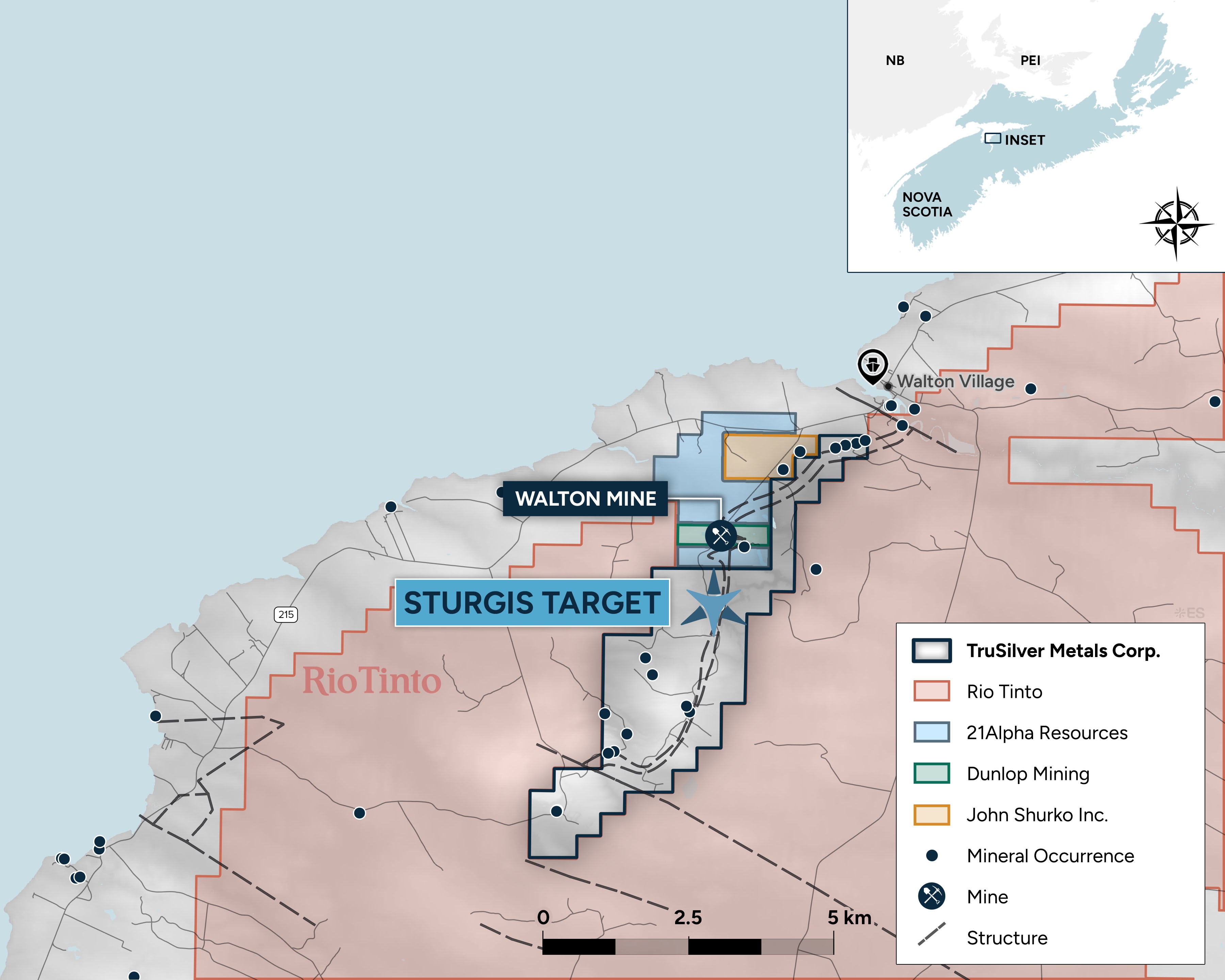
The Sturgis-Walton Silver Project
The project is currently permitted for drilling at three locations under a Crown Land exploration permit, valid through 2028.
TruSilver is planning a phased exploration program, beginning with drilling and additional geophysical work, followed by a larger Phase 2 program with approximately 3,500 metres of diamond drilling.
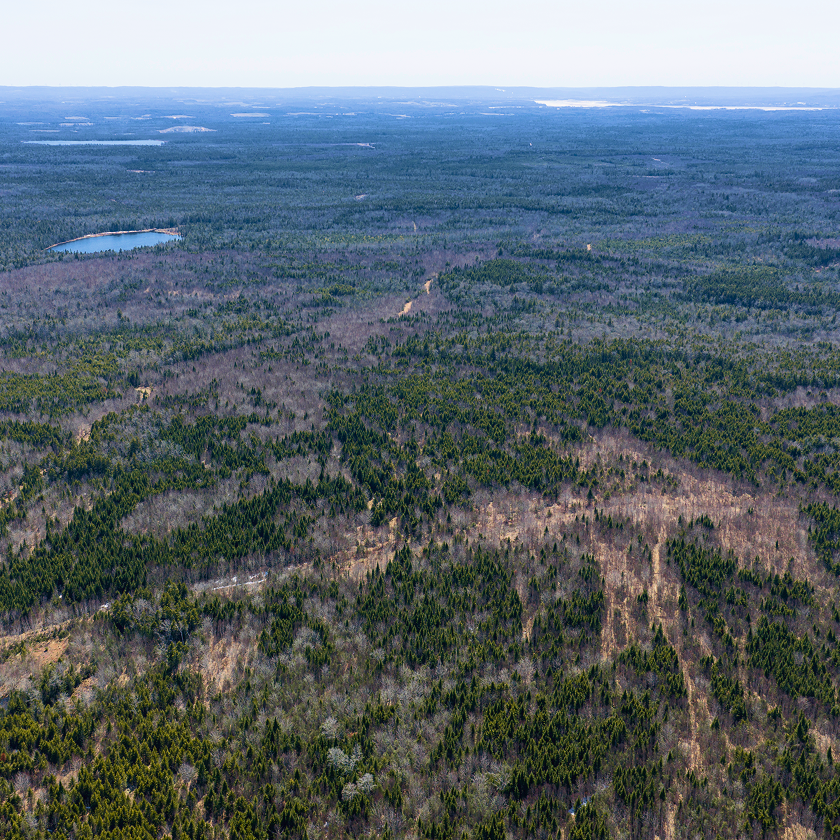
Walton Mine
The Walton Mine, located adjacent to the Sturgis-Walton Silver Project, operated from 1941 to 1978 and is recognized as one of Canada’s most historically significant polymetallic deposits.
The Walton Mine provides a strong geological analogue and underpins TruSilver’s exploration thesis that a larger, underlying feeder system may extend beyond the limits of historic mining.
Mining initially focused on barite production; however, as operations progressed to greater depths, significant silver, lead, zinc, and copper mineralization was encountered. The deposit is particularly notable for its high-grade silver content, with historical drill intercepts reported to include grades of up to approximately 5,754 g/t silver (185 oz/t Ag).*
¹Historic silver grade of 5,754 g/t Ag is derived from the reported 185 oz/ton Ag over 42 feet, converted to metric/modern being 5,754 g/tonne over 12.8 m in DDH174 (Level 690’) from Patterson, J.W. (1988), Walton Mine: Underground DDH & Assay Data, Nova Scotia Department of Mines & Energy, Open File Report ME 1988-045, and Patterson, J.W. (1988), Exploration Potential for Argentiferous Base Metals at the Walton Deposit, Nova Scotia, Open File Report 88-21. These historical results have not been verified by a Qualified Person, core for certain holes (including DDH 174) is incomplete andcannot be re-sampled, andshould not be relied upon without further drilling and QA/QC confirmation.
Historic underground development and drilling confirmed the presence of a high-grade mineral system hosted within carbonate rocks, consistent with a carbonate replacement deposit (CRD) model. Mining reached depths of approximately 500 metres before operations ceased, primarily due to water inflow associated with historical mining practices rather than depletion of the mineral system.
While substantial mineralization was historically extracted at Walton, the broader system has not been fully delineated or systematically tested using modern exploration techniques. Historic drilling and sampling confirm the presence of high-grade silver zones; however, the potential feeder system to the south remains largely untested, including its continuity, depth extent, and role as a possible source of the historic mineralization.
Geological Model
The Sturgis-Walton Silver Project is interpreted as an Irish-type carbonate replacement deposit (CRD) system, where mineralization is hosted within carbonate rocks and controlled by structural pathways. In this model, metal-bearing fluids migrate along faults and permeable horizons, replacing favourable host units and forming high-grade polymetallic zones.
Within this framework, the Walton Mine is interpreted as a higher-level expression of the system, while the Sturgis Target represents a deeper feeder structure, potentially associated with the primary fluid conduit and source of mineralization.
Exploration Work
Exploration in the Sturgis–Walton Silver Project area spans more than 150 years, beginning with the discovery of barite in the Walton area in 1860 and evolving through mining, geochemical surveys, geophysical programs, structural modelling, and modern diamond drilling.
The Project is located adjacent to the historic Walton Mine, a past-producing Zn-Pb-Cu-Ag-Ba operation that produced from 1941 to 1978. Historical and modern work in the area has focused on identifying extensions of Walton-style barite and base-metal mineralization along the Horton–Windsor Contact and within favourable carbonate host units.
Chronology of
Exploration Activity
South of Walton Mine)
Area (Goshen)
Lake & Lantz Area)
Sturgis Target
A large, deep geophysical anomaly defined by gravity, AMT, and magnetic data, interpreted as the core of the mine ral system.
Airborne magnetics
Gravity Surveys
AMT/MT surveys
Diamond drilling
The following has been conducted by TruSilver Metals Corp., or by its predecessor Basin Metals.
2020
2021
2023
2024
2025
2026
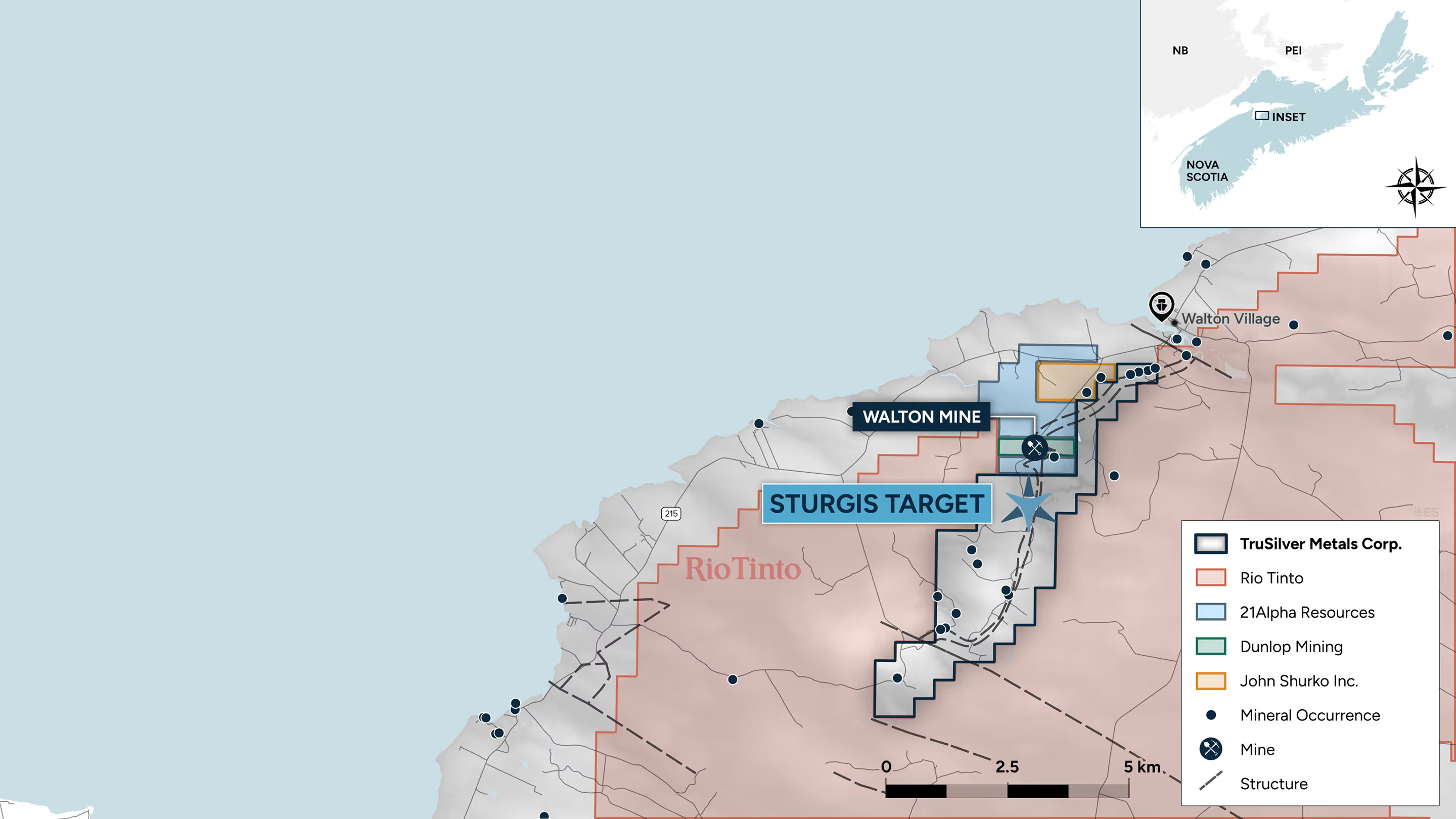
2026-2027 Drilling Program
Follow the Discovery
Be among the first to receive updates as TruSilver advances the Sturgis–Walton Silver Project.
Why It Matters
Follow the Discovery
Join our list to receive Sturgis-Walton Silver Project results and more.