Fresnillo, Mexico.
Centuries of shallow vein mining. A district-scale structural reinterpretation from 1990 to 1993. Blind high-grade silver veins found outside the historic workings between 1994 and 1999.6
In the 1960s a mine in rural Nova Scotia was pulling silver at grades most modern mines never see.
Then the ground caved and the water came in. By 1978 it was closed for good.
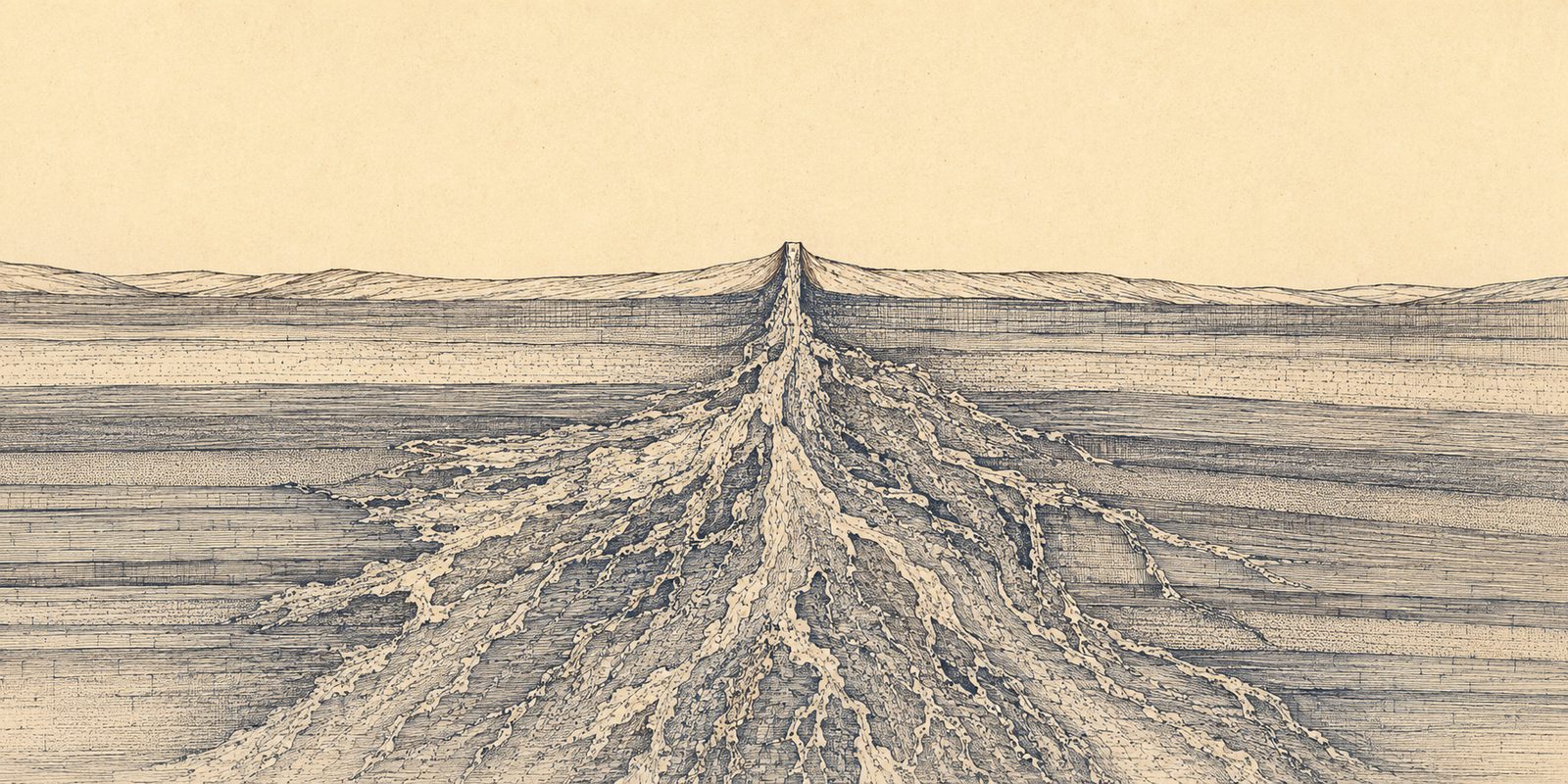
Our reading is that the mine only ever worked one “branch” of the system. If that's right, the “trunk” it grew off has never had a drill in it.
We've spent seven years working out where the rest of that system went. We own the ground it runs onto, we've got the permit, and just one of our planned holes could settle it.
We at TruSilver Metals Corp. hold 100% of the Sturgis-Walton Silver Project in Hants County, Nova Scotia. Seventy claims, three exploration licences, and no NSR on any of it.
The mine
The Walton Mine opened as a pit in 1941, digging barite. That's a heavy industrial mineral used in oil drilling, and for years this was one of the biggest barite producers in Canada.1
Then in 1955 a drill hole found something underneath it.1
Massive sulphide. Lead, zinc, copper and silver, sitting in a shattered zone below the barite. Underground development soon followed, and base metal production started in 1961.1
Mill feed produced from ore that delivered between 350 and 933 grams of silver per tonne.1
Individual holes ran far higher. DDH 174 cut 5,754 grams of silver per tonne and 0.6% copper over 12.8 metres. DDH 210 ran 1,233 grams over 24.1 metres.4
Read those numbers again. Especially the first one.
Then read this. Remember, they're historic, they predate modern reporting standards, no Qualified Person has verified them, and the core from DDH 174 no longer exists to re-sample.4
But in 1970 the underground began to take on water. Too much barite had been taken out and too little left to hold the ground up, so the workings progressively collapsed in on themselves. The fractures that opened let salty, sandy water in from the surrounding sediments and flooding began.1
The mine kept going as it progressively flooded, stripping high-grade barite and sulphides until 1978, then stopped with the removal of the crown pillars.15
Those workings sit on licences held by other companies, north and west of us.5
Here's where we came in: we care about the rock unit they were cut into. And we want to see if we can find samples that come in the same league as those historic “wow” numbers.
The hypothesis
That's the question this project starts from, and it's the reason there's a drill program at all.
Here's something many non-geologists might not already understand. The metal at Walton didn't begin where it was mined.3
Metal-bearing brine rises out of the deep basin along faults. It finds a bed of limestone it can chemically replace. Then it drops its load where the pH conditions change.3
So the plumbing matters just as much as the rock, if not more. There's a structure the fluid came up, and there are the places it spread out sideways once it got there.3
The carbonate replacement deposit classification is analogous to “Irish-Type”, after the belt in Ireland that hosts them.3
That isn't a stylistic comparison. Before the Atlantic opened, this ground and that ground were the same ground.3
A mine works whatever reaches surface. It doesn't get to choose.
Think of it like a tree.
Our reading is that Walton's operations worked one of the tree's branches. High in the system, and lucky enough to break surface where somebody could dig it in 1941.
Then the modern work started pointing somewhere else.
The surveys we ran in 2021 and 2024 found a large, dense anomaly at depth, southwest of the old workings.5
And the 2023 drill hole told us why the geometry is strange. This whole package has been folded and tipped over. That's what puts the deep part where it now sits, and why the rock sequence reads backwards in core.6
The trunk?
Put those together and you have the hypothesis this company was built to test.
Walton may have been a higher-level branch that happened to reach surface, with the trunk that fed it sitting deeper and to the southwest.
And as of now, no drill has ever been in it at depth.5
The academic economic geology view on this target is blunt: it has to be drilled.There's exactly one instrument that settles the rest.6
That's what the drill is for. To prove our theory correct.

Our ground
The Walton sulphides sat in a bed called the Macumber Formation. It's the horizon that does the work in this kind of deposit, and it runs onto our ground.63
And in 2023 we drilled that same formation.
Hole ST-23-01 went 557 metres down and cut two mineralized zones.2
The upper zone, from 359 to 377 metres, ran 12.15 g/t silver over 10.5 metres, including 0.6 metres at 149 g/t, with 0.044% copper over 18 metres. The lower zone, from 502 to 552 metres, ran 48.8 g/t silver over 19 metres, with 0.091% copper over 50 metres, including 8 metres at 0.35%.6
The hole did what it was drilled to do. It supported the structural interpretation.6
Same rock. Same style. Our side of the line.

The prediction
Jim Michaelis has been working this system for 45 years. His father-in-law worked underground at Walton.2
He came up as a project geologist with Gulf Minerals and then Billiton, and he built the 3D structural model this project is aimed at.2
That model said the whole package had been folded and tipped over.6
Which is an awkward thing to claim out loud. It means the rock reads backwards, and the target repeats where nobody would think to look.
ST-23-01 drilled through exactly that.
The sequence came up reversed. The hole crossed the Macumber twice. And between the two cuts, the core carries the fold itself.6
The model predicted upside-down rock. The drill found upside-down rock.
In September 2026 the company brought in Matt Rees as Vice-President, Exploration and a director. He spent more than eleven years at IAMGOLD, the last five as Chief Geologist, on a team that discovered or acquired roughly 29 million ounces of gold. Michaelis stays on as Strategic Technical Advisor.8
On the record
That year the Nova Scotia Department of Mines published its assessment of what Walton had produced. Its conclusion was that the high per unit value of the average ore, mainly due to the significant silver content, justifies exploration.4
Then the ground sat for the better part of three decades.
We're not the only ones interested now, either. Dr. Murray Hitzman of iCRAG, the Irish research centre where this deposit type is studied, has said that Nova Scotia has exactly Irish Type Deposits.6
He was talking about the province, not about our licences. But the Irish deposits are where the model we're drilling was worked out, and the comparison is one our own presentation already draws.
So we did the work to be able to drill it.
The depth
The Walton underground bottomed out at 500 metres. Then the ground gave way, the water came in, and in 1970 that was the beginning of the end of the argument.5
The holes we've permitted are planned to around 650 metres.5
Set those two beside each other.
What stopped a mine in 1970 isn't what stops our drill in 2026. And if we ever get to build our own mine, it won't be constructed in the same unsafe way as Walton was.
The number
Walton's production came from ore that yielded 350 to 933 grams of silver per tonne.1
In some Irish-type systems, silver and copper grades do increase closer to the feeder structure. That's been documented at Lisheen and at Silvermines.7
So the arithmetic in your head says a trunk would beat the branch.
We're not going to run that number. But we also won't stop you, if that's what you want to do with that information.
A feeder position tells you about plumbing. Where the fluid moved, where it had room to drop its load.
It doesn't tell you grade.
A gravity survey measures how heavy the rock is. Heavy rock at depth can be silver-bearing sulphide, or it can be barite or it can be iron with manganese.
So here's the narrower claim, and we can defend every word of it.
The structural position is right. The host formation is right. Our own hole found the right style of mineralization on the way toward it.
And nobody has ever put a drill in the thing itself. We aim to change that.
The pattern
Fresnillo. San Dimas. Cannington. Keno Hill. In every one, the discovery came after somebody re-read the geology. Not after somebody reopened the mine.6
Centuries of shallow vein mining. A district-scale structural reinterpretation from 1990 to 1993. Blind high-grade silver veins found outside the historic workings between 1994 and 1999.6
Around three hundred years of underground mining. Deep targeting and structural reinterpretation across 2016 and 2017. New deep and blind vein discoveries from 2017 to 2019.6
A regional brownfield district with no historic mine at the discovery site. Modern geophysics under cover from 1990 to 1992. A blind silver-lead-zinc system found in 1993.6
Mined from 1913 to 1989, then the camp closed. A camp-scale reinterpretation by Alexco from 2006 to 2009. New high-grade veins found outside the old stopes between 2009 and 2013, and Hecla acquired Alexco in 2022.6
One word repeats in every row. Blind.
A blind deposit leaves nothing at surface to find, which is why nobody finds one by walking the ground.
That's the category we're drilling into, and it's what the pattern looks like when somebody makes one of these.
These are comparables, not forecasts. None of them says anything about what sits under our licences.
The work
Every exploration story at this stage is a hypothesis with a test attached. Here's what sits behind ours.
Somebody drilled thirty-eight shallow holes in the Sturgis area in the late 1960s, then walked away.2
We tracked down the logs and digitised them. Two of those holes hit mineralization.2
Then our own seven years of activity. Drilling in 2019 and 2020, an airborne magnetic survey in 2021, the hole that worked in 2023, and gravity and AMT in 2024.6
Then the refined model, and the permits.5
We own it outright. One hundred percent, seventy claims, three licences, with no net smelter return royalty on any of it.2
It's already permitted, not just applied for. That permit runs to March 2028 and covers drilling at three locations.5
The province's own geologists said this ore justified exploration, and the academic view is that the target has to be drilled.46
The model has already been right once, under a drill.
In short
Three things make this project special to us.
We'll leave you with this thought. The hole that settles this hasn't been drilled yet. That's the open question in front of you.
Now you're at the beginning of our story, and how you handle that timing is up to you.
Follow the discovery
There are also two other important ways to view our overall story.
We respect your privacy. No unsolicited communications.
TruSilver Metals Corp. owns 100% of the Sturgis-Walton Silver Project in Hants County, Nova Scotia, about 70 kilometres northwest of Halifax. Seventy claims across three exploration licences, about 1,120 hectares, with no NSR.
A deep target southwest of the historic Walton Mine, identified by magnetic, gravity and AMT surveys. The working interpretation is that the historic mine worked a higher-level branch of a mineral system whose main feeder sits deeper and to the southwest. No drill has tested it at depth.
Yes. In 2023, hole ST-23-01 cut mineralization in the Macumber Formation, the same host unit the Walton Mine produced from, south of the historic workings, on ground TruSilver holds.
Yes. A Crown land exploration permit valid to March 4, 2028 authorizes drilling at three locations, plus access trails and 4.3 kilometres of line cutting.
No. TruSilver Metals Corp. does not own the Walton Mine. The historic mine and its workings sit on exploration licences held by other companies, immediately north and west of the Project. What TruSilver holds is the ground the same host formation runs onto.
The carbonate replacement deposit classification is analogous to Irish-Type, after the belt in Ireland that hosts them. Metal-bearing brine rises along faults, replaces a reactive carbonate bed, and concentrates where conditions change. The host unit at Walton and on TruSilver's ground is the Macumber Formation.
Pre-listing: through TruSilver's investor list and IR contact.
| # | Carries | Source |
|---|---|---|
| 1 | Walton history, production grades, the 1955 discovery, the flooding and the crown pillars | Mills, R., O'Reilly, G. and Donohoe, H., Selected Economic Mineral Deposits of the Walton Belt, Hants County. NSDNR Open File Report 2003-1. novascotia.ca/natr/meb/data/pubs/03ofr01/03ofr01.pdf |
| 2 | 100% ownership, no NSR, claims and licences, the 557 metre hole and its two mineralized zones, the historic Sturgis holes, and management background | Galaxy Ventures Inc., Enters Into Definitive Agreement with TruSilver Metals Corp., June 1, 2026. |
| 3 | Carbonate replacement deposit model at Walton | Sangster, D.F., Burtt, M.D. and Kontak, D.J., Geology of the B Baseline Zone, Walton Cu-Pb-Zn-Ag-Ba Deposit. Economic Geology 93(6), 1998, 869-882. doi.org/10.2113/gsecongeo.93.6.869 |
| 4 | Historic intercepts at Walton including DDH 174 and DDH 210, and the 1989 assessment that the ore justified exploration | Patterson, J.W. (1988), Walton Mine: Underground Drill Hole & Assay Data, NSDNR Open File Report ME 1988-045; and Exploration Potential for Argentiferous Base Metals at the Walton Deposit, Open File Report 88-21. Historic, unverified by a Qualified Person. |
| 5 | Mine depth, the permit and its three locations, the untested deep target, and the planned hole depth | TruSilver Metals Corp., Project Overview. trusilvermetals.com/project-overview |
| 6 | The trunk and branch interpretation, the 2023 intercepts, the overturned structure, the seven-year work sequence, the Hitzman quote, the academic view that the target has to be drilled, and the brownfield comparables | TruSilver Metals Corp. corporate presentation. trusilvermetals.com |
| 7 | Elevated silver and copper at feeder-proximal zones, Lisheen and Silvermines | Torremans, K. et al., The Carbonate-Hosted Tullacondra Cu-Ag Deposit, Mallow, Ireland. Minerals 11(6), 560, 2021. doi.org/10.3390/min11060560 |
| 8 | Matt Rees appointment and background, Michaelis’s advisory role, the closed C$2,510,090 financing and related-party participation | Galaxy Ventures Inc., Announces Major Milestones for Qualifying Transaction: TruSilver Completes $2.5 Million Financing and Appoints Former IAMGOLD Chief Geologist Matt Rees as Director and Vice-President of Exploration, September 15, 2026. trusilvermetals.com/news-releases |
Qualified Person: Jeff Burke, P.Geo., a Qualified Person as defined by National Instrument 43-101, has reviewed and approved the scientific and technical information in this web page. Mr. Burke is an employee of the Company and is not independent to the Company.
Mr. Burke has reviewed the available geological, geophysical and drilling information relating to the Sturgis-Walton Silver Project, including the geological records, drill logs, assay information, survey results and quality assurance and quality control information supporting the current exploration information disclosed on this webpage.
Information concerning the historic Walton Mine, including its historical production, drilling and assay results, has been obtained from the historical sources identified on this webpage. The Walton Mine is located on mineral licences that TruSilver does not own and is adjacent to the Sturgis-Walton Silver Project.
Mr. Burke has not independently verified the historical Walton Mine results. Certain original records, samples and drill core, including the core from DDH 174, may no longer be available for verification or re-sampling. Historic silver grade of 5,754 g/t Ag is derived from the reported 185 oz/ton Ag over 42 feet, converted to metric/modern being 5,754 g/tonne over 12.8 m in DDH 174. These historical results have not been verified by a Qualified Person, core for certain holes (including DDH 174) is incomplete and cannot be re-sampled, and should not be relied upon without further drilling and QA/QC confirmation. The historical results should not be relied upon without further confirmation and are not necessarily indicative of mineralization that may be present on the Sturgis-Walton Silver Project.
Historical results are derived principally from Patterson, J.W. (1988), Walton Mine: Underground Drill Hole & Assay Data, Nova Scotia Department of Mines and Energy, Open File Report ME 1988-045; Patterson, J.W. (1988), Exploration Potential for Argentiferous Base Metals at the Walton Deposit, Open File Report 88-21; and Mills, R., O’Reilly, G. and Donohoe, H., Selected Economic Mineral Deposits of the Walton Belt, Hants County, Nova Scotia Department of Natural Resources Open File Report 2003-1.
This webpage contains forward-looking information within the meaning of applicable Canadian securities laws. Forward-looking information includes statements concerning TruSilver’s exploration plans, proposed drilling and geophysical programs, geological interpretations, exploration targets, the possible continuation or geometry of mineralized structures, the branch-and-trunk exploration model, the potential relationship between the Sturgis-Walton Silver Project and the historic Walton Mine, and the possibility of discovering mineralization.
Forward-looking information is based on management’s current expectations, estimates, assumptions and interpretations, including assumptions concerning the availability of financing and personnel, receipt and continued effectiveness of permits, access to the Project, contractor and equipment availability, geological continuity, interpretation of historical and current exploration information, and the timely completion of planned exploration activities.
Forward-looking information involves known and unknown risks, uncertainties and other factors that may cause actual results to differ materially from those expressed or implied. These factors include exploration and drilling risks, geological uncertainty, the speculative nature of mineral exploration, the possibility that geological interpretations or exploration models may prove incorrect, the possibility that drilling will not intersect significant mineralization, permitting and environmental risks, availability of financing, commodity-price fluctuations, operating and contractor risks, and other risks associated with mineral exploration. There is no assurance that planned exploration will be completed as proposed or that it will result in the discovery or definition of a mineral resource.
The comparisons to the historic Walton Mine, Irish-Type deposits and other mineral districts are provided solely for geological context. They are not forecasts, projections or indications that mineralization of similar grade, size, continuity or economic significance exists or will be discovered on the Sturgis-Walton Silver Project. No mineral resource or mineral reserve has been defined on the Project, and there is no assurance that further exploration will result in one being defined.
Readers should not place undue reliance on forward-looking information. Forward-looking information is provided as of the date of this webpage, and TruSilver disclaims any intention or obligation to update it except as required by applicable securities laws.
Neither the TSX-V nor its Regulation Services Provider (as that term is defined in the policies of the TSX-V) accepts responsibility for the adequacy or accuracy of this release.
Not for distribution to United States newswire services or dissemination in the United States. The securities described have not been registered under the U.S. Securities Act of 1933 and may not be offered or sold in the United States absent registration or an applicable exemption.